

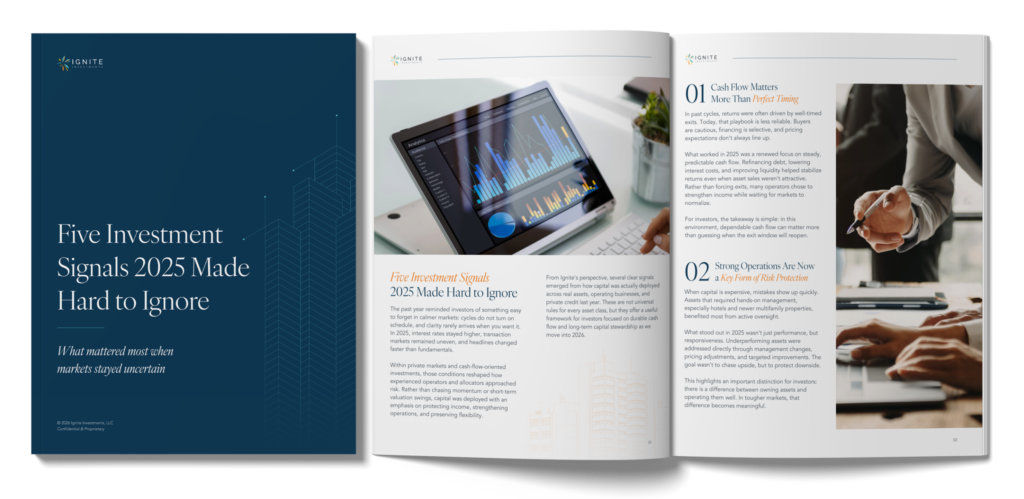
The past year reminded investors of something easy to forget in calmer markets: cycles do not turn on schedule, and clarity rarely arrives when you want it. In 2025, interest rates stayed higher, transaction markets remained uneven, and headlines changed faster than fundamentals.
Within private markets and cash-flow-oriented investments, those conditions reshaped how experienced operators and allocators approached risk. Rather than chasing momentum or short-term valuation swings, capital was deployed with an emphasis on protecting income, strengthening operations, and preserving flexibility.
From Ignite’s perspective, several clear signals emerged from how capital was actually deployed across real assets, operating businesses, and private credit last year. These are not universal rules for every asset class, but they offer a useful framework for investors focused on durable cash flow and long-term capital stewardship as we move into 2026.
1. Cash Flow Matters More Than Perfect Timing
In past cycles, returns were often driven by well-timed exits. Today, that playbook is less reliable. Buyers are cautious, financing is selective, and pricing expectations don’t always line up.
What worked in 2025 was a renewed focus on steady, predictable cash flow. Refinancing debt, lowering interest costs, and improving liquidity helped stabilize returns even when asset sales weren’t attractive. Rather than forcing exits, many operators chose to strengthen income while waiting for markets to normalize.
For investors, the takeaway is simple: in this environment, dependable cash flow can matter more than guessing when the exit window will reopen.
2. Strong Operations Are Now a Key Form of Risk Protection
When capital is expensive, mistakes show up quickly. Assets that required hands-on management, especially hotels and newer multifamily properties, benefited most from active oversight.
What stood out in 2025 wasn’t just performance, but responsiveness. Underperforming assets were addressed directly through management changes, pricing adjustments, and targeted improvements. The goal wasn’t to chase upside, but to protect downside.
This highlights an important distinction for investors: there is a difference between owning assets and operating them well. In tougher markets, that difference becomes meaningful.
3. Essential, Everyday Businesses Continue to Attract Capital
While some sectors stalled, others quietly kept performing. Assets tied to daily needs, convenience retail, travel centers, healthcare services, and similar businesses continued to show resilience.
These investments share a few common traits: consistent demand, simpler operating models, and less reliance on economic optimism. In many cases, long-term leases and essential services helped provide stable income even as broader markets slowed.
For high-net-worth investors, this isn’t about being overly defensive. It’s about recognizing where demand tends to hold up, regardless of headlines.
4. Patience Is an Active Decision, Not a Lack of One
Extended holding periods can be frustrating, but in 2025 they often reflected discipline rather than delay. Selling assets into uncertain pricing environments rarely rewarded urgency.
Instead, many operators focused on preparing assets, improving operations, validating performance, and staying ready for when conditions improve. That meant making progress without forcing outcomes.
The lesson here is straightforward: time alone doesn’t create risk. Poor timing does. Waiting with purpose can be just as strategic as acting quickly.
5. Private Credit Is Becoming a Core Part of the Toolkit
One of the most notable shifts in recent years has been the growth of private credit. As banks pulled back, private capital stepped in, often with more flexible structures and clearer alignment.
Revenue-based funding and private lending strategies gained traction in 2025 because they offered access to cash-flowing businesses without relying on asset sales or aggressive leverage. Importantly, many of these strategies were tested internally before being offered more broadly, reinforcing a focus on proof over promise.
For investors, private credit is no longer a niche idea. It’s increasingly a practical way to stay invested and generating income when traditional markets slow down.
Looking Ahead
None of these signals suggest dramatic change. Instead, they reflect a market that rewards discipline, operational strength, and patience. In this part of the cycle, success has less to do with bold forecasts and more to do with doing the fundamentals well, day after day.
From Ignite’s perspective, the investors and operators best positioned for 2026 are those focused on cash flow, downside protection, and flexibility. Those qualities may not generate headlines, but they tend to hold up when markets test convictions.
The information contained herein is for informational and educational purposes only and is not an offer to sell or a solicitation of any offer to buy any securities. The information contained herein is not intended to and does not constitute investment, legal, or tax advice, or recommendation of any services or products for sale and is not intended to provide a sufficient basis on which to make an investment decision. Any investment in securities involves a high degree of risk and may not be suitable for all investors and you should consult with an expert before making investment decisions. The views or opinions expressed herein represent those of Ignite Investments, LLC (“Ignite”) or its affiliated sponsors at the time of publication. No assurance can be provided that any of the future events referenced herein (including but not limited to projected or estimated returns or performance results) will occur on the terms contemplated herein or at all. While the data contained herein has been prepared from information that Ignite believes to be reliable, Ignite does not warrant the accuracy or completeness of such information. Examples provided are for illustrative purposes only and not intended to be reflective of results you can expect to achieve. Please see Terms & Conditions for full disclosures.
Investments in commercial real estate (CRE) involve significant risks, including market risks, interest rate risks, and liquidity risks, and may not be suitable for all investors.
Securities transactions conducted through Umergence, LLC. Member: FINRA/SIPC. Umergence is not affiliated with any entities identified in this communication.
© 2026 Ignite Investments, LLC